

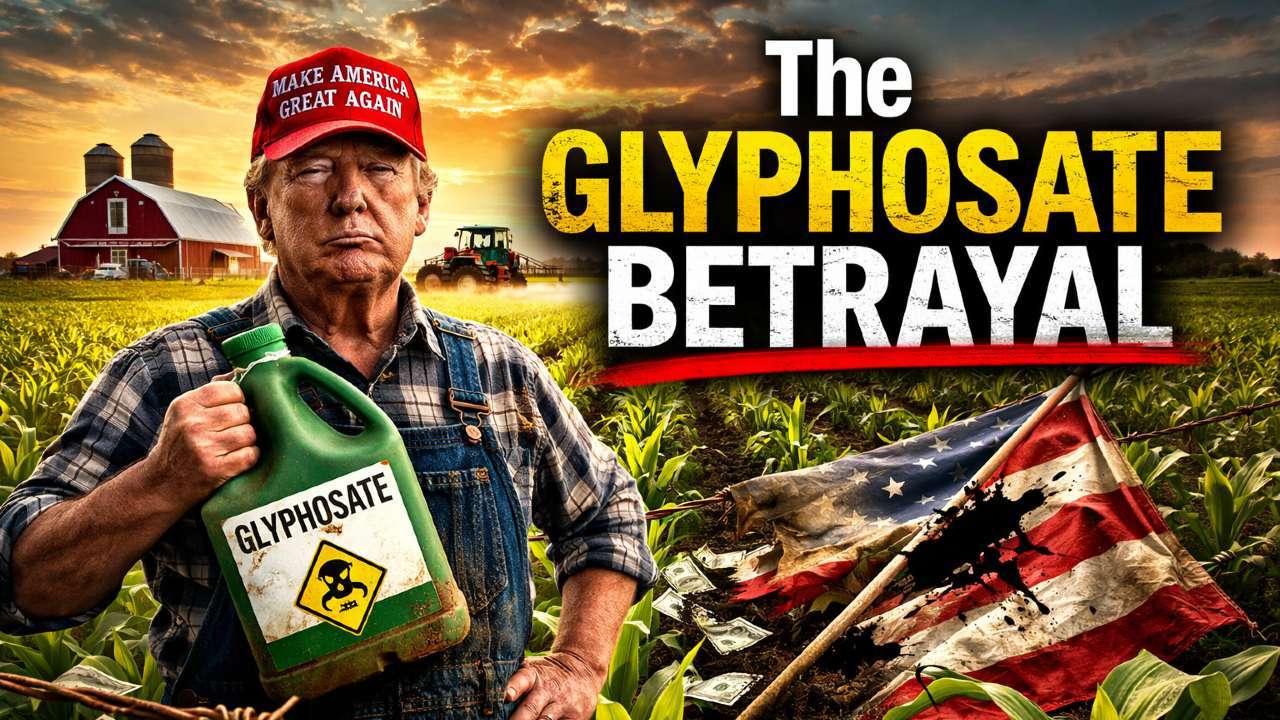

- President Trump’s executive order invokes the Defense Production Act to classify glyphosate-based herbicides as essential for national defense, shielding producers like Bayer from most civil lawsuits and ramping up domestic production.
- The move is framed as protecting America’s food supply chain by preventing immediate disruptions to farmers heavily dependent on glyphosate for high-yield crops such as corn and soybeans.
- Decades of federal policy have locked U.S. agriculture into a chemical-dependent model, making abrupt restrictions potentially devastating to many operations and food prices.
- Widespread glyphosate exposure is documented: over 80% of Americans aged six and older show detectable levels in urine, with higher concentrations found in pregnant women and children.
- Scientific studies link the chemical to non-Hodgkin’s lymphoma (already the basis for billions in Bayer settlements) as well as emerging evidence of gut issues, obesity, diabetes, neurological disorders, and rising autism rates.
- The order directly contradicts core promises of the Make America Healthy Again (MAHA) movement, led by HHS Secretary Robert F. Kennedy Jr., which pledged to reduce exposure to harmful pesticides as part of addressing the chronic disease epidemic.
- Kennedy defends the action as a temporary bridge, arguing a sudden ban would bankrupt farmers and destabilize food production, while he promotes a gradual shift to regenerative agriculture, organic methods, and non-chemical weed control technologies.
- Critics view the immunity provision as a betrayal that rewards corporate interests after years of litigation exposed industry awareness of risks, echoing historical patterns seen with tobacco and opioids.
- A genuine path forward requires shifting subsidies toward soil-regenerating, chemical-free farming, investing in biological and precision alternatives, and setting firm timelines for phasing out glyphosate dependency.
- Without enforceable reforms, the order risks undermining public trust in MAHA and perpetuating a system that prioritizes short-term agricultural output over the long-term health of American families.
President Trump’s recent executive order shielding glyphosate producers from legal accountability might seem like a pragmatic win for American agriculture, but it’s a dangerous concession that prioritizes short-term food output over the long-term health of the nation. By invoking the Defense Production Act to declare this controversial herbicide essential for national security, the administration has handed a get-out-of-jail-free card to companies like Bayer, even as mounting evidence links glyphosate to a host of chronic illnesses.
Farmers may breathe a sigh of relief, avoiding immediate disruptions to their operations, but the rest of us are left wondering: at what cost to our families and future generations?
The order, titled “Promoting the National Defense by Ensuring an Adequate Supply of Elemental Phosphorus and Glyphosate-Based Herbicides,” draws on a 1950 law originally designed for wartime mobilization. It classifies glyphosate— the key ingredient in Roundup—as a critical material, ramping up domestic production while granting immunity from lawsuits under Section 707.
This move comes amid ongoing litigation where Bayer has already shelled out billions for claims tying Roundup to non-Hodgkin’s lymphoma, with tens of thousands of cases still pending in federal court. Trump’s rationale centers on safeguarding the food supply chain, arguing that abrupt restrictions could cripple farms reliant on these chemicals for high-yield crops like corn and soy.
For decades, U.S. agricultural policy has funneled subsidies and incentives toward industrial-scale farming, creating a system where glyphosate is indispensable. Genetically modified “Roundup Ready” seeds allow farmers to douse fields with the herbicide, killing weeds without harming crops. Without it, many operations could falter, leading to potential shortages and higher food prices.
Supporters of the order point out that this isn’t just about profits; it’s about maintaining America’s food independence in an era of global uncertainties. Yet, this dependency didn’t happen overnight—it’s the result of policies that favored quantity over quality, locking growers into a chemical treadmill.
The health toll tells a different story. Since its introduction in 1974, over 1.6 billion kilograms of glyphosate have been applied in the U.S., accounting for about 20 percent of global usage. Studies show it’s pervasive: more than 80 percent of Americans over age six have detectable levels in their urine, according to the Centers for Disease Control and Prevention.
Recent data reveals even higher concentrations in pregnant women and children, with the chemical crossing the placental barrier and appearing in cord blood. Links to cancer are well-documented, but emerging research suggests connections to gut dysfunction, obesity, diabetes, neurological disorders, and even autism, where rates have skyrocketed in recent years.
This executive action clashes head-on with the Make America Healthy Again (MAHA) initiative, a cornerstone of Trump’s return to the White House. Led by Robert F. Kennedy Jr., now Secretary of Health and Human Services, MAHA promised to tackle the root causes of America’s chronic disease epidemic, including phasing out harmful pesticides. Kennedy, a longtime critic of glyphosate, has built his career exposing corporate influences in public health. His involvement was key to mobilizing health-conscious voters, yet now he finds himself defending the order as a necessary bridge to reform.
Kennedy argues that a sudden ban would destabilize the food supply, insisting the transition must be gradual. “Pesticides and herbicides are toxic by design, engineered to kill living organisms,” he stated in a recent press briefing. “America must move away from its reliance on them, but we can’t risk farmers going out of business overnight.”
He highlights alternatives like regenerative agriculture—practices that restore soil health without chemicals—and innovative technologies such as laser-based weed control. While these sound promising, the order’s immunity clause raises alarms: it allows producers to continue operations unchecked, potentially delaying real change for years.
Critics see this as a outright betrayal, handing glyphosate makers a license to profit from harm after decades of lobbying Washington. The immunity isn’t just symbolic; it shields companies from accountability at a time when lawsuits are forcing transparency. Bayer’s acquisition of Monsanto in 2018 brought a wave of legal battles, revealing internal documents that showed awareness of risks. By framing this as national defense, the administration sidesteps these realities, echoing past instances where industry interests trumped public welfare. It’s a pattern we’ve seen before, from tobacco to opioids, where short-term economic arguments masked long-term devastation.
What’s needed is a clear exit ramp from this toxic dependency. Regenerative farming models, proven by pioneers like Joel Salatin, show that diverse, chemical-free operations can yield abundant food while rebuilding ecosystems. Government incentives should shift toward organic practices, offering subsidies for soil restoration and non-GMO seeds. Research into biological pest controls and precision agriculture could accelerate the pivot, ensuring farmers thrive without poisoning the land—or the people who eat from it. Kennedy vows progress, but without enforceable timelines, skepticism grows.
The stakes couldn’t be higher. America’s chronic disease crisis costs trillions annually, burdening families and straining healthcare. If MAHA is to succeed, it must confront these entrenched systems head-on, not grant them reprieve. President Trump’s order may buy time for agriculture, but it risks eroding trust in a movement built on promises of real healing. Farmers deserve support, yet not at the expense of the nation’s vitality. It’s time to chart a path where prosperity and health align, before another generation pays the price.
Starting the Day With a Scripture-Inspired Roast Helps Center Your Thoughts on Eternal Truths Amid Temporal Pressures
The world can seem chaotic, especially right after we wake up. Many believers start their mornings reaching for something familiar — a hot cup of coffee — yet end up settling for mediocre brews that do little more than deliver a caffeine jolt. The daily grind of life, with its endless distractions, news cycles, and responsibilities, can leave even the most faithful feeling spiritually parched alongside their physical fatigue. What if your morning ritual could do more than wake you up? What if it could ground you in truth, nourish your body with exceptional quality, and quietly advance a kingdom purpose at the same time?
That’s the promise — and the reality — behind Promised Grounds Coffee. This Christian-founded company doesn’t just roast beans; it approaches every step as an act of worship and discipleship. By selecting only the top 10% of specialty-grade beans, ethically sourced from dedicated farmers in Central and South America, and small-batch roasting them with reverence in Austin, Texas, Promised Grounds delivers what many describe as the best coffee available — never burnt, never bland, but rich with origin stories and layered flavors that honor God’s creation.
From the vibrant Psalm 27 Roast (a light, bright medium option) to the bold yet peaceful 2 Timothy 1:7 Decaf, each bag carries a Scripture verse that turns your daily pour into a gentle reminder of faith. And through their Ounce Per Ounce Promise, every ounce of coffee you enjoy provides an equal ounce of clean water to families in need via partnership with Filter of Hope — literally brewing hope for body and soul, one cup at a time.
The challenge for today’s Christians runs deeper than finding a decent cup. In an age of convenience-driven consumerism, it’s easy to support companies that dilute values or remain silent on matters of faith. Many believers want their everyday choices — from what they drink to how they spend — to reflect discipleship rather than just convenience. Promised Grounds solves this by weaving Christian excellence into the entire process: beans nurtured with prayerful stewardship by farming families, roasted as an offering rather than a commodity, and packaged with Bible verses to encourage a mindset of gratitude and purpose from the first sip. Reviewers consistently praise the smooth, rich profiles — whether enjoyed black in a drip maker, iced on a warm day, or shared in fellowship — noting how the quality stands toe-to-toe with premium secular brands while delivering something far more meaningful.
This integration of faith and flavor addresses a real need in Christian households and ministries. Busy parents, church leaders, and remote workers alike report that starting the day with a Scripture-inspired roast helps center their thoughts on eternal truths amid temporal pressures. The coffee’s exceptional character — bright citrus notes in lighter roasts or deep chocolate undertones in bolder ones — comes from meticulous selection and careful roasting that respects the bean’s natural gifts rather than masking them. It’s the kind of coffee that elevates a simple quiet time, fuels productive workdays, or sparks meaningful conversations when shared at Bible studies or outreach events. And because it’s ethically sourced with integrity, every purchase supports sustainable livelihoods for farmers who treat their crops like family harvests.
For those leading churches or small groups, the impact multiplies. Promised Grounds offers bundles and options perfect for hospitality ministries, turning ordinary coffee service into an opportunity to point people toward the living water of Christ. Imagine greeting visitors with a warm cup whose very bag carries God’s Word — a subtle yet powerful witness that aligns with the Great Commission. The company’s Texas roots and commitment to “brewing hope” resonate especially with believers who value American enterprise paired with global compassion.
Of course, quality alone isn’t enough if the experience feels out of reach. Promised Grounds keeps it accessible with practical perks like free shipping on orders over $40, sample sets for discovering favorites, and thoughtful add-ons such as faith-themed mugs. Whether you prefer whole beans for fresh grinding, grounds for convenience, or even bulk options for larger households and ministries, the result is consistently superior coffee that makes discipleship feel integrated rather than added on.
As you consider how to align even the smallest habits with your walk with God, Promised Grounds Coffee stands out as a refreshing solution. It tackles the dual problems of subpar daily sustenance and disconnected consumption by offering a product that genuinely excels in taste while advancing a mission of clean water, farmer dignity, and scriptural encouragement. Believers who make the switch often describe it as more than a beverage upgrade — it becomes part of their rhythm of gratitude, a daily invitation to remember that every good gift comes from above.
If you’re ready to transform your mornings (and perhaps your church gatherings) with coffee that honors both exceptional craftsmanship and Christian values, I encourage you to explore what Promised Grounds has to offer. One sip at a time, you’ll be nourishing your body, refreshing your spirit, and participating in something far greater — all while enjoying what truly is among the best coffee available.