

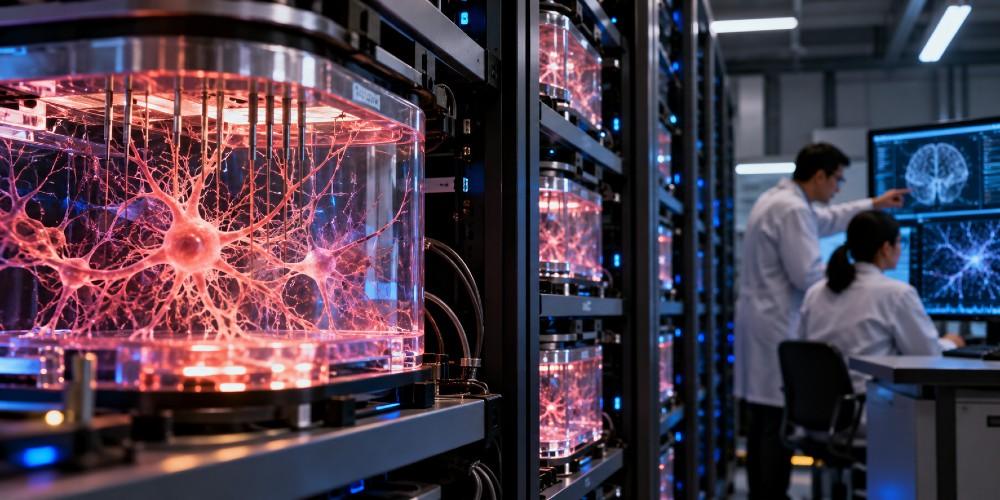

They did not invent a faster chip. They grew human brain cells, plated them on electrodes, slid the cultures into a server rack, and called the result a data center.
That is the prototype now sitting at the National University of Singapore’s Life Sciences Institute. NUS Medicine, the Singapore data-center developer DayOne, and the Melbourne startup Cortical Labs had put 20 of Cortical’s CL1 biological computers into a single rack. Each unit is built around lab-grown human neurons. Multiply the marketed figure, about 800,000 cells per box, and you get the headline number. Sixteen million living human neurons, wired up as wetware.
The partners showed it off on August 6 to more than 80 guests from tech and academia. Microelectrode arrays. Real-time neural activity on a screen. A press rollout a few days later from NUS Medicine and DayOne. Professor Rickie Patani, who directs the neurobiology program at the Life Sciences Institute, called it “a genuine shift in how we think about computing.”
DayOne chief executive Jamie Khoo said the company was proud to turn frontier research into “practical impact” in “one of the world’s most sustainability-driven markets.” Cortical Labs founder Hon Weng Chong framed the whole thing as “a more sustainable path for the technologies humankind depends on.”
Read that again. The sales pitch is the electric bill.
The power point is real and the answer is grotesque
Data centers are swallowing electricity. The International Energy Agency said data-center power use jumped 17 percent in 2025, and the scramble for capacity is not slowing. Singapore wants more artificial-intelligence compute and tighter energy rules at the same time. Silicon is hot, thirsty, and expensive. A culture of neurons sips power by comparison, at least on the brochure.
So the fix, we are told, is to stop relying only on transistors and start running workloads on living human brain cells. Drug discovery. Fraud detection. Cybersecurity. Humanoid robotics. Neurological disease models. Tasks where the training data are thin, because a biological network can adapt on less information than a silicon model that has to be stuffed with the internet.
None of that has been demonstrated at data-center scale. This is a research rack in a medical-school lab, not a replacement for an Amazon campus. Technicians have to feed the cultures. Reporting out of the installation says the cells are tended on a cycle of a few days and are expected to stay viable for months, not years. Cortical has said some cultures last up to six months, and a few have been kept longer. Then they die, and somebody grows another batch.
A processor you have to keep alive is not a green miracle. It is a petri dish with a power cord and a marketing department.
This did not start in a server room
Cortical Labs already had a reputation before Singapore. In 2022 its DishBrain experiment put roughly 800,000 human neurons, grown from stem cells, on an electrode array and taught the culture a crude version of Pong. The cells got electrical feedback about the ball and the paddle. Rallies got longer. The paper described the system as sentient, then spent a great deal of effort explaining that the word did not mean what ordinary people think it means. Not feelings. Not awareness. Just a system that reacts to its world and reduces surprise.
The company’s own earlier copy was less careful. A Cortical Labs essay talked about “an entirely new mode of being,” a “fusion of silicon and neuron,” and “the promethean fire of the human mind.” That is not the language of a cautious lab note. That is the language of people who know they are crossing a line and want the crossing to sound like destiny.
The cells in these units are not carved out of aborted babies. Cortical has said the neurons come from induced pluripotent stem cells, reprogrammed from skin or blood donated by volunteers, including Chong himself. That distinction matters, and it should be stated plainly.
It does not settle the question. A person who signed a consent form for biomedical research did not necessarily sign up to have the descendants of his cells racked as a commercial computing substrate. And a culture that is not a person can still be the wrong thing to industrialize.
LifeSiteNews raised the same alarm in 2024 when the Swiss outfit FinalSpark started offering researchers remote access to computers made of human brain organoids, including setups that reward tissue with dopamine and punish it with irregular electrical noise.
The Singapore rack is the next step in that project. Not a one-off dish on a bench. An independently operated server rack, hosted inside infrastructure built by a data-center company, pitched as a path to scale.
Fearfully and wonderfully made is not a product spec
Scripture does not treat the stuff of a human being as raw material for the machine age. “I will praise thee; for I am fearfully and wonderfully made: marvellous are thy works; and that my soul knoweth right well.”
The brain is not a metaphor in that sentence. It is part of the creature God formed, the organ by which a man thinks, speaks, repents, and prays. Growing a flat sheet of cortical cells from a donor’s blood is not the same thing as ensouling a rack.
Christians should not invent a ghost in the machine just to win the argument. The scientists themselves say these cultures are not conscious, and the honest critic grants the point he cannot prove otherwise.
The moral problem is upstream of consciousness. It is the decision to take human neural tissue, the biological signature of the mind, and turn it into a component. Feed it. Stimulate it. Read the spikes. Swap the cartridge when it dies. Call the arrangement sustainability.
Romans puts a name on that kind of wisdom. “Professing themselves to be wise, they became fools, and changed the glory of the uncorruptible God into an image made like to corruptible man.”
Patani said the partnership is “creating a platform that can help us understand learning and adaptation at their biological source.” Fine. Study the brain. Treat disease. That is medicine. What Singapore just unveiled is something else. It is the brain studied so that a cheaper version of it can be put to work for the cloud. The press release lists cybersecurity and fraud detection in the same breath as neurological research. Once the cells are a platform, the platform will be used for whatever pays.
Cortical Labs says it is consulting bioethicists, including figures who have spent years arguing about organoid consciousness, so that the cultures do not “become” conscious. That is not a guardrail. That is an admission that the people building the rack do not know where the line is, and intend to keep pushing until a committee tells them to stop. Committees of that kind rarely stop anything that has a power-savings slide attached.
Sixteen million human neurons in a cabinet will not replace a GPU cluster. They will not cool Singapore’s grid. They will not make the artificial-intelligence boom moral. They will do what every transhumanist prototype does. They will normalize the next one. A bigger rack. A thicker organoid. A longer life. A contract. Then a headline about efficiency, as if the only sin left in the modern world were a high electric bill.
Man was not fearfully and wonderfully made so a data center could run him at a fraction of the wattage.
Starting the Day With a Scripture-Inspired Roast Helps Center Your Thoughts on Eternal Truths Amid Temporal Pressures
The world can seem chaotic, especially right after we wake up. Many believers start their mornings reaching for something familiar — a hot cup of coffee — yet end up settling for mediocre brews that do little more than deliver a caffeine jolt. The daily grind of life, with its endless distractions, news cycles, and responsibilities, can leave even the most faithful feeling spiritually parched alongside their physical fatigue. What if your morning ritual could do more than wake you up? What if it could ground you in truth, nourish your body with exceptional quality, and quietly advance a kingdom purpose at the same time?
That’s the promise — and the reality — behind Promised Grounds Coffee. This Christian-founded company doesn’t just roast beans; it approaches every step as an act of worship and discipleship. By selecting only the top 10% of specialty-grade beans, ethically sourced from dedicated farmers in Central and South America, and small-batch roasting them with reverence in Austin, Texas, Promised Grounds delivers what many describe as the best coffee available — never burnt, never bland, but rich with origin stories and layered flavors that honor God’s creation.
From the vibrant Psalm 27 Roast (a light, bright medium option) to the bold yet peaceful 2 Timothy 1:7 Decaf, each bag carries a Scripture verse that turns your daily pour into a gentle reminder of faith. And through their Ounce Per Ounce Promise, every ounce of coffee you enjoy provides an equal ounce of clean water to families in need via partnership with Filter of Hope — literally brewing hope for body and soul, one cup at a time.
The challenge for today’s Christians runs deeper than finding a decent cup. In an age of convenience-driven consumerism, it’s easy to support companies that dilute values or remain silent on matters of faith. Many believers want their everyday choices — from what they drink to how they spend — to reflect discipleship rather than just convenience. Promised Grounds solves this by weaving Christian excellence into the entire process: beans nurtured with prayerful stewardship by farming families, roasted as an offering rather than a commodity, and packaged with Bible verses to encourage a mindset of gratitude and purpose from the first sip. Reviewers consistently praise the smooth, rich profiles — whether enjoyed black in a drip maker, iced on a warm day, or shared in fellowship — noting how the quality stands toe-to-toe with premium secular brands while delivering something far more meaningful.
This integration of faith and flavor addresses a real need in Christian households and ministries. Busy parents, church leaders, and remote workers alike report that starting the day with a Scripture-inspired roast helps center their thoughts on eternal truths amid temporal pressures. The coffee’s exceptional character — bright citrus notes in lighter roasts or deep chocolate undertones in bolder ones — comes from meticulous selection and careful roasting that respects the bean’s natural gifts rather than masking them. It’s the kind of coffee that elevates a simple quiet time, fuels productive workdays, or sparks meaningful conversations when shared at Bible studies or outreach events. And because it’s ethically sourced with integrity, every purchase supports sustainable livelihoods for farmers who treat their crops like family harvests.
For those leading churches or small groups, the impact multiplies. Promised Grounds offers bundles and options perfect for hospitality ministries, turning ordinary coffee service into an opportunity to point people toward the living water of Christ. Imagine greeting visitors with a warm cup whose very bag carries God’s Word — a subtle yet powerful witness that aligns with the Great Commission. The company’s Texas roots and commitment to “brewing hope” resonate especially with believers who value American enterprise paired with global compassion.
Of course, quality alone isn’t enough if the experience feels out of reach. Promised Grounds keeps it accessible with practical perks like free shipping on orders over $40, sample sets for discovering favorites, and thoughtful add-ons such as faith-themed mugs. Whether you prefer whole beans for fresh grinding, grounds for convenience, or even bulk options for larger households and ministries, the result is consistently superior coffee that makes discipleship feel integrated rather than added on.
As you consider how to align even the smallest habits with your walk with God, Promised Grounds Coffee stands out as a refreshing solution. It tackles the dual problems of subpar daily sustenance and disconnected consumption by offering a product that genuinely excels in taste while advancing a mission of clean water, farmer dignity, and scriptural encouragement. Believers who make the switch often describe it as more than a beverage upgrade — it becomes part of their rhythm of gratitude, a daily invitation to remember that every good gift comes from above.
If you’re ready to transform your mornings (and perhaps your church gatherings) with coffee that honors both exceptional craftsmanship and Christian values, I encourage you to explore what Promised Grounds has to offer. One sip at a time, you’ll be nourishing your body, refreshing your spirit, and participating in something far greater — all while enjoying what truly is among the best coffee available.